

Beijing Trip Report
Impressions from a week in the Middle Kingdom in the wake of Trump and Putin visits.

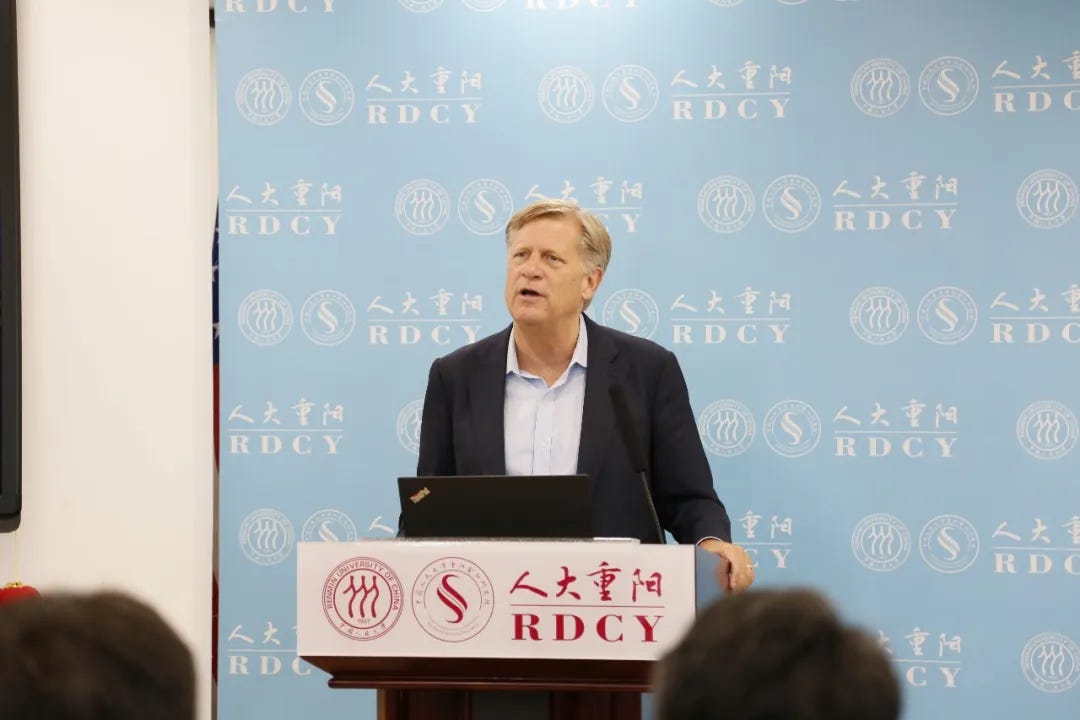
Last week, I was in Beijing. My primary reason for traveling to China was to speak at a conference hosted by the Stanford Center at Peking University. But, as I usually do when traveling to China, I also spoke at several other universities --- including other parts of Peking University, Tsinghua University, Renmin University, and Foreign Affairs University. I also attended roundtables with American and Chinese businesspeople, and checked in, as I traditionally do, with colleagues at the Asian Infrastructure Investment Bank (AIIB) and the Ukrainian embassy. This time around, I did not have time to make it down to the US embassy, which is very far from Peking University’s campus. Still, I heard readouts of the Trump-Xi meeting from American and European journalists, as well as from Chinese academics who had attended post-summit briefings organized by the Chinese government. I also heard the same from various sources about the Xi-Putin summit, which happened just a few days after President Trump left.
Impressions, interviews, and data gathered on this trip will feed into more formal writings I will do in the future. In this piece, I am sharing a few general impressions, recognizing that these are just anecdotes and hot takes rather than digested academic research.
I am not an expert on China. I do not speak Mandarin or Cantonese. I am a consumer of knowledge about China, not a producer. However, because China is such an important country for anyone claiming expertise in international relations (remember, the endowed chair I have in political science at Stanford is the Ken Olivier and Angela Nomellini Professor in International Studies!) I have tried to learn as much as I can about the country and firmly believe that you cannot understand a country without seeing it. Since my first trips to the People’s Republic of China in the late 1980s, including spending summers at Peking University in 2015 and 2019 conducting research, I have tried to go as often as I can, usually about once a year. Since the 1990s, China, as a “case study,” has also featured prominently in my courses on the political economy of post-communism, revolutions, comparative foreign policy decision-making, and great power competition, which I’m teaching now.
I do get nervous when crossing the border in and out of China. I do worry that there will come a time when I will not be allowed to travel to the PRC. Other American academics have been denied visas. The US government has also refused visas to dozens of Chinese scholars, according to colleagues in Beijing. This tit-for-tat game is imprudent. So too is the expulsion of journalists, which tragically the Chinese government just did again by canceling the visa of New York Times correspondent Vivian Wang. Of course, the United States government should not give visas to Chinese spies, and vice versa. But I do believe that both countries benefit from understanding each other, and that’s why Chinese Communist Party (CCP) leaders should want American experts on China to travel to their country, and Washington should want Americanists from China to be as well-informed as possible. At the same time, to keep my visa, I never self-censor what I write or say about China even when I am there. Last week, I talked about democracy and human rights generally, wrongly detained persons (including mentioning Jimmy Lai by name), persecutions in Xinjiang, and other sensitive topics. My last book is titled Autocrats vs Democrats: China, Russia, America and the New Global Disorder, and you don’t have to read very deeply into the book to figure out which side I consider the Chairman of the Communist Party of China, Xi Jinping, to be on. But last week, I got in and out without any drama.
And I hope that continues because even just a week in China always leaves a big impression.
Regarding US-China relations, I spoke with many Chinese professors and analysts who echoed the confidence Xi displayed during his meeting with Trump. The assessment of the United States as a declining power and China as a rising power is held by many. I do not share that view; the epilogue of my last book is titled “Don’t Bet Against America Yet.” And some of China’s best specialists on the United States also do not subscribe to the conventional wisdom in Beijing that the United States is a declining power. I talked to some of them on this trip. But I came back from Beijing less confident in my assessments than before. During the Trump-Xi summit, the United States appeared weak, and that may be because it is weaker today than it was when Trump last visited Beijing in 2017. Tensions with allies, trade disputes with nearly the entire world, an unnecessary war against Iran, and deep polarization at home put Trump in a much weaker position for this summit than the last time he met with Xi. (For more on this topic, see this essay.) But it was also the optics of the summit that signaled a changing balance of power. Trump constantly praised Xi as a close friend and great leader. Xi did not reciprocate. I was told that this lack of praise for Trump was intentional, in part because Xi remembered that tariffs and confrontational policies soon followed the final summit they held in Beijing in 2017. Xi did not want to get burned again.
Behind closed doors, or so I heard multiple times last week from Chinese colleagues, Xi pressed Trump hard on American and Japanese support for Taiwan. Xi felt emboldened to do so in part because of Trump’s weak position internationally, but also because Xi did not back down when Trump tried to impose expansive tariffs against China, but instead pushed back by threatening to cut off rare earth exports. In that game of chicken last year, Xi held firm, and Trump backed down. So, Xi was feeling confident during the summit and emboldened to push harder on Taiwan than in previous meetings. The consensus among scholars I met last week in Beijing is that Xi got what he wanted on Taiwan. Judging by Trump’s subsequent comments, including his decision to delay arms shipments in Taiwan, maybe my Chinese colleagues were right. Strikingly, Secretary of Defense Peter Hegseth gave a speech in Singapore this week in which he did not mention Taiwan once in his prepared remarks.
Xi wanted to foster a positive atmosphere in his meeting with Trump but was in no mood to give the American president big gifts. I heard from many people last week that Chinese commitments to buy Boeing aircraft and American agricultural goods were more modest than hoped. In talking to American businesspeople in Beijing, some of whom had been working in China for decades, I found they feared tougher days ahead regarding trade deals and even harder times to come regarding investment.
At the same time, most people I met in Beijing last week celebrated the summit as a win-win outcome for US-China relations. Most of my interlocutors were in better spirits about America and Trump than they were during my last visit to Beijing last spring. Many celebrated Trump’s willingness to accept the new Chinese framing of bilateral relations as “constructive strategic stability.” By the end of my stay, that phrase was rolling off the tongues of everyone as if it had been around for years or decades. Message discipline among officials and academics connected to the Chinese government is striking. For some Chinese observers, Trump’s acceptance of the Chinese phrase was also seen as another sign of China’s rise and America’s decline.
“Constructive strategic stability” reminded me of other catchy phrases in great-power relations, such as “détente” between the United States and the Soviet Union in the 1970s or “reset” between the U.S. and Russia in the 2010s, when I was working in the Obama administration. In my talks around town (I gave seven altogether, including one in Russian!), I began my remarks by celebrating this new détente as well, but then reminded my audiences why détente between the United States and the Soviet Union in the 1970s eventually failed. My lecture at Renmin University was on the record, so if you read Chinese, you can see how the press covered it here. I don’t read Mandarin, so I’m not sure what these stories say. However, I can tell you that the audience reaction to my caution about future US-China relations was disappointment. I was told many times that I was too pessimistic. Most controversially, I explained that Soviet overreach in Afghanistan ended détente, subtly warning that Beijing overreach regarding Taiwan would lead to a similar backlash and end of détente 2.0 in US-China relations. Once they understood the analogy, my Chinese colleagues assured me that Xi had no intention of invading Taiwan now and was more focused on peaceful means of reunification.
As a side note, having visited Taiwan twice in the last few years, I always get the sense when in the PRC that Beijing does not understand how much Taiwan has changed. It reminds me of Putin’s misreading of Ukrainian society. Peaceful reunification is not going to be as easy as many in Beijing assume. But I’ll come back to this topic in a separate essay.
Putin was also in Beijing when I was there. (He did not invite me over to the Russian embassy for tea.) Both the similarities and differences with the Trump-Xi summit are worth noting. Regarding differences, the two governments issued two joint statements and announced over twenty agreements. The United States and China issued no joint statements. Putin and Xi are obviously closer than Trump and Xi, and that was on display too, both in their language and their mannerisms. At the same time, I was struck by some similarities. First, the Chinese press emphasized Putin’s praise of Xi and China, not the other way around. The headline of the China Daily story on the summit was “Putin hails ‘unprecedented level’ of ties.” The headline was not “Xi hails ‘unprecedented level’ of ties.” The symbolism of all world leaders coming to pay their respects to the great leader of the Middle Kingdom was one that many of my Chinese colleagues emphasized. Several European leaders had also been recently to Beijing. After a century of humiliation, China had returned to its rightful status as a great power in the world, or so I was told. Second, like Trump, Putin did not leave Beijing with big deliverables to bring home. Above all else, he did not get Xi to agree to build the Power of Siberia II pipeline. Chinese experts on Russia told me that Xi does not feel the need to commit to this expensive project when China can import Russian hydrocarbons at a discounted price because of Western sanctions. I also asked many Chinese experts on Russia – I have gotten to know this crowd well over the many years of interaction with them -- why Xi continues to allow Chinese components to find their way to Ukraine via third countries that are then used to build Ukrainian drones. I was told that Putin wants China to stop this trade, but Xi does not feel the need to do so. Russia-China relations are closer than ever before. Putin and Xi are also very tight. But these bilateral relations are not without limits.
Every time I travel to China, there is always some new economic development that catches my eye. On this trip, I was struck by the number of electric vehicles (EVs) on the roads, and very fancy ones at that. I rode from the airport to Peking University in an EV van fully loaded with all sorts of AI-enhanced features, including the ability to open and close doors with voice commands. Since I spent a summer in Beijing in 2015, the city’s air quality has also improved tremendously. In addition, like at home (I live in Silicon Valley), almost every conversation with economists and businesspeople focused on AI and robots. The race is on. I heard many stories about amazing breakthroughs soon to come. Many of my Chinese colleagues in these conversations, however, stressed that this competition need not be zero-sum, and that our governments needed to cooperate to establish guardrails against the most pernicious uses of AI (i.e., the development of bioweapons). On this point, I agree.
When discussing the Chinese economy with professional economists – i.e, professors in departments of economics at Peking or Tsinghua universities – the story of China’s booming success became more sober. Growing economic inequality, cutthroat competition leading to too much production, demographic challenges, and bad policy decisions by the Chinese Communist Party were recurrent themes.
Another impression I want to share came from a session I had with students from Stanford and Peking University. In that meeting, we eventually got around to the topic of my last book, and one student very eloquently argued that the glory days of democratic systems of government are over, and China’s system of government created more permissive conditions for sustained economic growth, including for entrepreneurs. I pushed back. I asked how well the Chinese system was working for Jack Ma, the Chinese entrepreneur who lost control of the multi-billion dollar company and now, according to press reports, lives in Japan. The student pushed back, saying Ma was just “one case.” I rebutted that claim by citing other instances of the ”grabbing hand” of the Chinese state – not Adam Smith’s “invisible hand” -- destroying or weakening other private Chinese companies. I then fell back on the correlation over hundreds of years between democratic institutions and economic growth. (When I got home, I even pulled off the shelf the classic by Doug North, Institutions, Institutional Change, and Economic Performance to refresh my memory of these arguments!) I must admit, however, that I spent the next hour in transit to my next meeting downtown – Beijing is a big city! – wondering whether the Chinese autocratic model is sui generis and capable of sustaining economic development, including even entrepreneurship, in ways never seen before in world history. Dan Wang’s important book, Breakneck: China’s Quest to Engineer the Future, came to mind, in which he argues that those governing China are mostly engineers and those governing the United States are mostly lawyers, and that gives China an edge. I’m still not convinced. In the long run, I still think China’s model of economic development will face difficulties, just as other autocracies in Asia did when they tried to move from middle-income to high-income economies. But it’s a hypothesis that constantly needs to be revisited as more data becomes available. That one conversation/debate alone made the trip to Beijing worthwhile.
Relatedly, I also left Beijing more convinced than ever that the free world needs to be united to engage with and compete more effectively with China and its autocratic allies. If we continue to go it alone, as Trump seems to prefer, we have no chance.
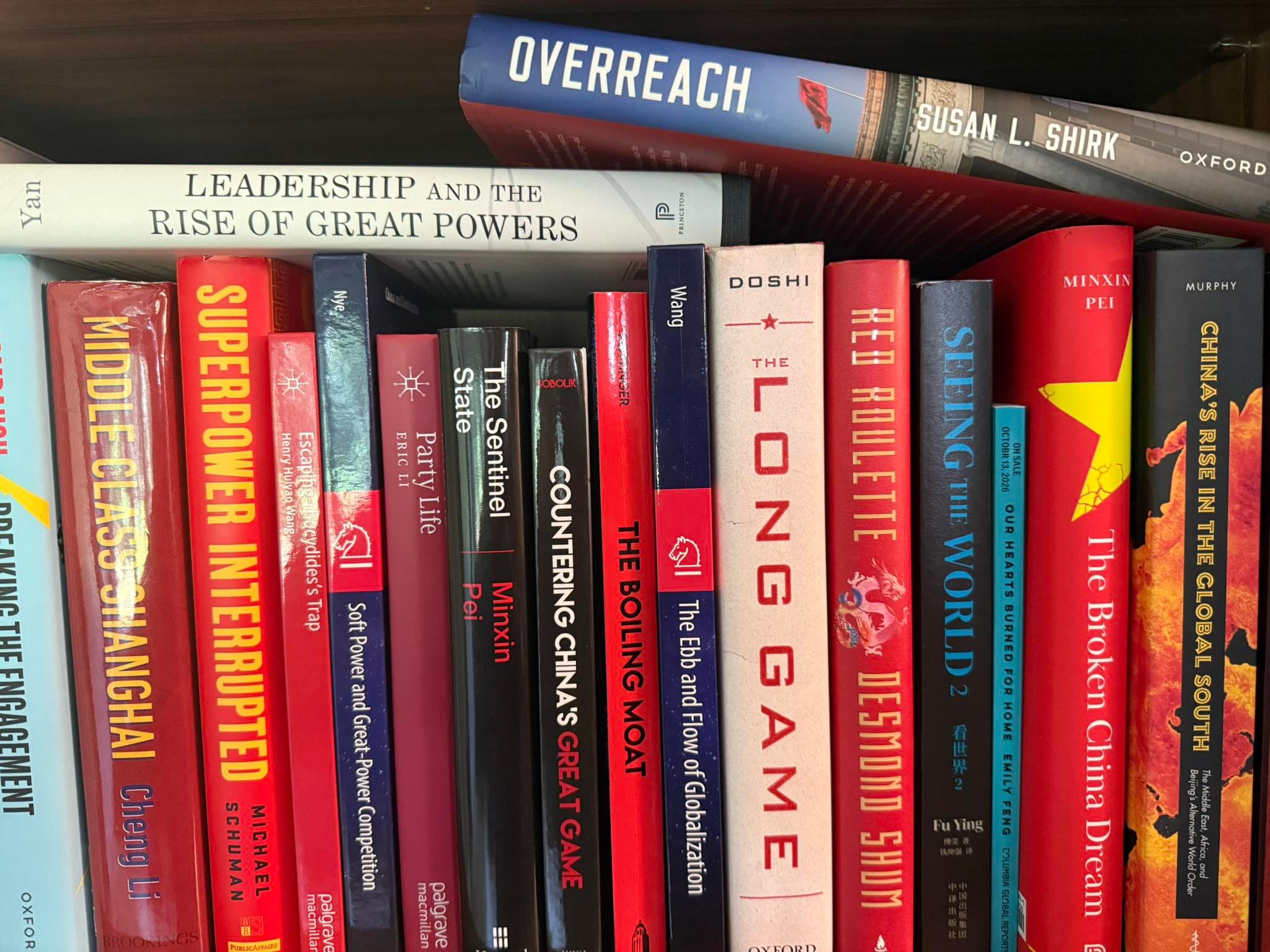
Travel, especially to complex and important places like China, is always stimulating. I got back to campus more motivated to read many of the books on China that I have bought over the last few years! If you get the chance, do more travel this summer! I have trips planned to both Europe and Asia. I’ll report back again.
Thank you. I miss your voice in “our conversations.”We’re in dire need of your perspective Prof
Fascinating. Thanks for being on scene abs sharing.