
The Case for Selective Economic Decoupling with Autocracies
US leaders should continue selectively decoupling in key economic and security domains

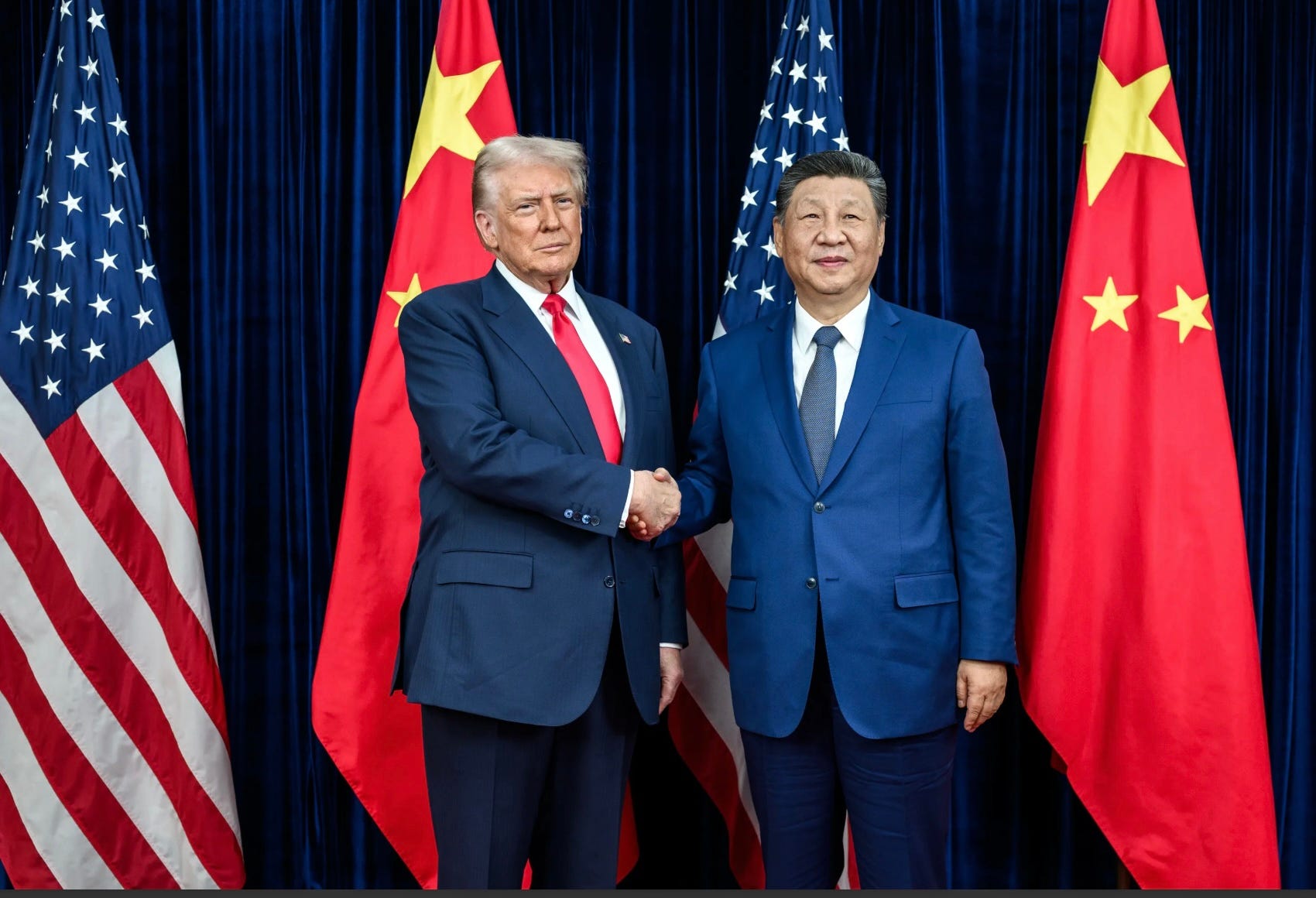
President Trump’s decision to reverse the Biden administration’s policy and allow NVIDIA to sell its second-most powerful chips, the H200, to China has sparked a heated debate in Washington, D.C., and Silicon Valley. The announcement has raised legitimate fears that Beijing will use the advanced AI technology to accelerate the modernization of its own military. At the same time, a strategy of completely cutting off Chinese companies from America’s leading technology companies will not work either. I wrestled with this balance in Autocrats vs Democrats: China, Russia, American and the New Global Disorder. What follows below is a set of principles and ideas adapted from the book.
On the one hand, we cannot return to the Cold War, when the global economy was divided into two blocs, but we also cannot continue to engage with the Chinese economy in ways that help the Chinese military modernize or give Chinese companies unfair advantages. The same is true for Russia and other adversaries. The prudent strategy is selective decoupling. American leaders should continue to pursue decoupling in domains where our core security and economic interests are threatened, but maintain, if not even expand, engagement in areas where our economic interests are advanced. That is a challenging Goldilocks balancing act, but it is the only prudent course.
Some U.S. core interests require complete decoupling. For instance, curtailing the export to China of the most sophisticated chips needed to develop artificial intelligence – such as NVIDIA’s H200 – is a worthy objective, as the Biden administration started to do, even while realizing that such efforts have prompted the CCP to devote more resources to developing China’s chip industry, and also triggered Chinese trade restrictions on the United States. But we can slow down the development of their AI capabilities, including those that can be harnessed for the military purposes, by refusing to sell them our most advanced chips.
More generally, American leaders must be more aggressive in stopping all technological transfers, investments, and research collaborations that help to modernize Chinese and Russian military capabilities. For instance, too many technological components from the United States and other democracies continue to find their way into Russia and then are used to build Russian weapons that kill Ukrainian soldiers and civilians. (For details, see “Challenges of Export Controls Enforcement How Russia Continues to Import Components for Its Military Production,” Working Group Paper #16, January 11, 2024.)
That must stop. American companies also cannot be assisting Chinese breakthroughs in AI or quantum computing, especially technological advances that strengthen the Chinese military. The U.S. government should provide permissive conditions to stimulate competition between AI companies, including those developing open models as the only strategy for competing with Chinese AI companies around the world, but also do so in ways that do not benefit People’s Liberation Army targeting, DeepSeek’s development, or CCP data collection on Americans, our allies, and partners.
American efforts to expand controls on exports of sensitive technologies to China and Russia should also be internationalized and institutionalized among the democratic community of states. That was the case during the Cold War when the United States took the lead in establishing the Coordinating Committee for Multilateral Export Controls (CoCom) to limit the transfer of goods and technologies of military value to the Soviet Union and other communist states. CoCom was hard to enforce but produced positive results in large part because the organization was international. We need a new CoCom for the free world today to limit the transfer of military and dual-use technologies to China and Russia and to coordinate sanctions policy among democracies more generally. The current architecture is too balkanized, too leaky, and not yet designed to address new challenges in the 21st century, such as stopping financial flows to malicious actors through cryptocurrencies.
In parallel, U.S. controls on American investments in companies producing military technologies in China and Russia must be internationalized within the community of democracies. Controls on investments in democracies, limits on sensitive technologies, and transparency and constraints on investment outflows to autocracies could be rolled into one new international organization comprised of democracies. It could be called the International Committee on Foreign Investments in Democracies (ICFID), modeled after the U.S. Committee on Foreign Investment in the United States (CFIUS). Because the U.S. has more capacity than other democracies to review foreign investment and real estate transactions for national security reasons, we could share this intelligence with our allies and partners through this new organization. ICFID could designate certain companies and their IP as critical for security. Once a company obtains such a designation, a package of incentives to firms from democratic countries could automatically kick in to keep these assets with allies and friends and away from adversaries.
To underscore, selective investment and export controls of technology transfer—not comprehensive limits—is the prudent strategy. While restricting the export of high-end chips or limiting the use of open-source AI models for the People’s Liberation Army, American strategists must also remember that AI has many non-military applications, including healthcare and education, that U.S. leaders should not want to impede in China or any country. In fact, the U.S. should want to encourage Chinese citizens to use Western AI products as a way to subvert the Chinese digital wall, reducing the flow of information into China. The same should be true for Russia. The Chinese Communist Party and Putin have successfully blocked media and social media platforms from reaching Chinese and Russian citizens. We do not want to help them achieve similar success in blocking information that might come from AIs. More generally, open-source AI models are an essential element of a robust, innovative ecosystem for AI development in the United States and the rest of the world. Although a difficult balance to achieve, we must preserve that ecosystem without helping the militaries of our adversaries.
The United States will be competing with China in high-tech sectors for decades to come. To do so effectively, we must carve a delicate path between complete decoupling and complete coupling. Strategies designed to cut off China completely from buying from or interacting with America’s most successful tech companies are neither necessary nor will they succeed. But allowing Chinese companies to buy everything from American tech giants in the name of profit maximization is also imprudent, especially when those American technologies can be used to enhance China’s military capabilities. The best strategy, if also the hardest to design and implement, is selective decoupling. Today, the Trump administration is moving too fast towards more coupling. It’s time to recalibrate and pivot back to a more Goldilocks solution.
Liked what you read? See also:
Why Trump Is So Popular in China
Axis, Rivalry, Or Chaos? The US-China-Russia Equation With Michael McFaul | China Considered
American technologies that can be used to enhance China’s military capabilities are also, apparently, being used to enhance Russia's military capabilities---one of the benefits Russia gets from China for buying their oil. I do not have a source to cite here (but it was likely a Russia scholar or think tank), but perhaps our author or other readers do.