

Ukraine Is Winning
This spring, the stalemate on the battlefield has shifted in Ukraine's favor, complementing other Ukrainian victories in the war.

This essay is the second in a two-part series.
For part one, see: Growing Cracks in Putin’s Dictatorship.
When Vladimir Putin launched his full-scale invasion of Ukraine in February 2022, many observers believed that time was on his side. The size of Russia’s army, combined with Moscow’s massive military-industrial complex, would surely give it the advantage on the battlefield. Over time, that advantage would have a decisive effect—or so many believed.
The re-election of US President Donald Trump reinforced this assumption. Trump himself stated repeatedly that Ukraine had “no cards,” suggesting it was time for Ukrainian President Volodymyr Zelenskyy to capitulate. In the first year of his second term, Trump cut direct military assistance to Ukraine to almost zero (but did allow American military companies to profit by selling their weapons to NATO allies, which then transferred these weapons to Ukraine). Worse yet, Trump then tried to pressure Zelenskyy to capitulate to Putin, urging him to give up parts of the Donbas still held by Ukrainian soldiers. This past winter, the Russian military launched a massive campaign against Ukrainian energy infrastructure in a desperately cruel attempt to break Ukrainian morale once and for all.
But winter gave way to spring, and Ukraine did not break. Now, in the fifth year of Putin’s barbaric invasion, the assumption that time is on Russia’s side seems to be increasingly inaccurate. The longer this war drags on, the more likely it is that time may, instead, be on Ukraine’s side.
Losing Some Battles but Winning the War
Over the first four years of the war, Ukraine has scored major offensive successes, especially in 2022, but has also lost many individual battles for cities and villages. However, even while losing control of some territory since Russia’s full-scale invasion in 2022, Ukrainians have prevented Putin from achieving any of his core war aims.
First, Putin aimed to unite Russians and Ukrainians, whom he considers to be “one people.” Ukrainians, in his view, are just Russians with accents. Regarding this war objective, Putin has failed miserably. Ukrainians did not welcome his invading army as liberators. Just 0.3% of respondents of a 2023 poll conducted in non-occupied Ukraine said that they wanted their country to unite with Russia, according to the Kyiv International Institute for Sociology. At the same time, support for joining Western political and security institutions has grown. A 2026 poll by the Kyiv Security Forum found that 83% of respondents wanted Ukraine to join the European Union (EU), while 73% supported its accession to NATO. Just a few months before Putin launched his full-scale invasion of Ukraine, these figures stood at 55% and 48%, respectively. Maybe more than any other historical event, Putin’s full-scale invasion in 2002 has solidified Ukrainian national identity.
Second, Putin did not achieve his second war objective—regime change or what he oddly calls “denazification.” (Nazis do not rule Ukraine.) Zelenskyy, his security detail, and all Ukrainian warriors have prevented Putin from overthrowing the democratically elected president and parliament. In the first days of the full-scale invasion, Zelenskyy evaded multiple assassination attempts. Putin’s original dream of installing a pro-Kremlin puppet to rule Ukraine seems more fantastical today than ever before.
Not only have Ukrainians thwarted Putin’s plan to kill Zelenskyy and install a Kremlin-friendly puppet, but they have also succeeded in practicing democracy throughout the duration of the Russian invasion. New elections have not been held, but their postponement under martial law has been carried out in accordance with the provisions of the Ukrainian Constitution. Furthermore, independent media, civil society, and anti-corruption government organs have continued to hold Zelenskyy, his government, and the parliament accountable. How else can you explain the resignation and indictments for corruption of some of Zelenskyy’s closest advisors? Independent media face constraints that should be lifted, but democracy is still Ukraine’s form of government. Putin’s dream of regime change has failed.
Third, after more than four years of fighting, Ukrainians have continued to deny Putin his revised, more limited war aim of annexing major chunks of Ukrainian territory. Recall that when launching his full-scale invasion in 2022, Putin aimed to conquer all of Ukraine, sending his tanks and special forces to Kyiv, not Donetsk. When that operation failed, he adjusted his war aims to more modestly focus on annexing eastern regions of Ukraine that Putin’s refers to as “Novorossiya.” In pursuit of this objective, Russian forces have made some gains, bringing the total percentage of occupied territory to roughly 20% since 2014, when Putin first seized control of Crimea and parts of Donbas. But Russia’s advance has gradually slowed. Over the last year, Russian soldiers seized control of roughly 1,427 square miles—only 0.6 percent of Ukraine’s territory. (For the details, see the impressive work of the Institute for the Study of War.) Importantly, Russia’s 2026 spring offensive was a complete disaster. Putin has not even conquered Donbas, the territory consisting of two regions—Donetsk and Luhansk— that he has been seeking to acquire since first invading Ukraine twelve years ago. In an indirect admission of his military failure, Putin even asked Trump to pressure Zelenskyy into handing over this territory to Russia. That request, allegedly agreed to by Trump during his meeting with Putin in Alaska last summer, has been rejected by Zelenskyy.
This spring, Ukraine has made incremental and localized gains along the frontline. Oleksandr Syrskyi, commander-in-chief of the Armed Forces of Ukraine, said his soldiers had reclaimed roughly 600 square km of land in 2026, including 100 square km in May alone. DeepState, the open-source project partly funded by the Ukrainian government, reported that in the four weeks from May 12 to June 9, Russia suffered a net loss of 1 square mile of territory, compared with the previous four-week period, when Russian soldiers secured a net gain of 41 square miles. Independently verifying such claims is difficult, given how dangerous the front line is right now. And offsetting some Ukrainian gains are new losses. One such place is Kostyantynivka, a city in the strategically significant “Fortress Belt”, where Russia has made recent gains. However, in its 10 June 10th report, the Institute for the Study of War (ISW) assessed that although it expected Russia to make further local gains there this summer, it was “unlikely to make operational gains against the Fortress Belt writ large.” Few analysts believe that momentum is still on Russia’s side. In fact, independent analysts, Russian military bloggers, and Kremlin propagandists all agree that Ukrainian soldiers have gained the upper hand on the frontline.
Fourth, the Armed Forces of Ukraine are gaining the upper hand on the front line because of another victory—the establishment and development of increasingly innovative drone companies. (To learn more about the development of Ukraine’s defense tech sector, check out Snake Island Institute.) Dozens of Ukrainian drone companies now work directly with Ukrainian commanders to provide new drones on a weekly and sometimes daily basis. These companies then gain battle-tested experience for their products and innovate, update, and improve accordingly. The scale has also expanded enormously: in 2026, Ukrainian drone companies plan to produce 7 million drones.
The world first witnessed Ukraine’s new defense tech prowess in 2022-2023, when Magura sea drones in the Black Sea effectively eliminated Russia’s navy from the war. But at the front, too, Ukrainian drone makers have continued innovating to penetrate deeper into Russian-occupied territory, making it nearly impossible for any Russian soldier to move within a kill zone of an estimated 20- 30 km on the frontline. This year, the Ukrainian deployment of mid-range drones, and especially the American-made, AI-enhanced Hornet drones (thank you, Eric Schmidt and Perennial Autonomy!), have crippled Russian supply lines, especially along the so-called Novorossiya highway, deep into occupied territories. Russia has yet to deploy a counter to these new weapons systems, making the road connecting occupied Ukrainian territories to Crimea nearly impossible to use. Once this horrific war is over, Ukrainian drone companies will emerge as some of, if not the, best in the business and eventually become a key component of the European defense industrial base. For instance, the Ukrainian drone company UFORCE has already attracted sufficient Western investment to become a Ukrainian unicorn, valued at $1.5 billion. Others will follow.
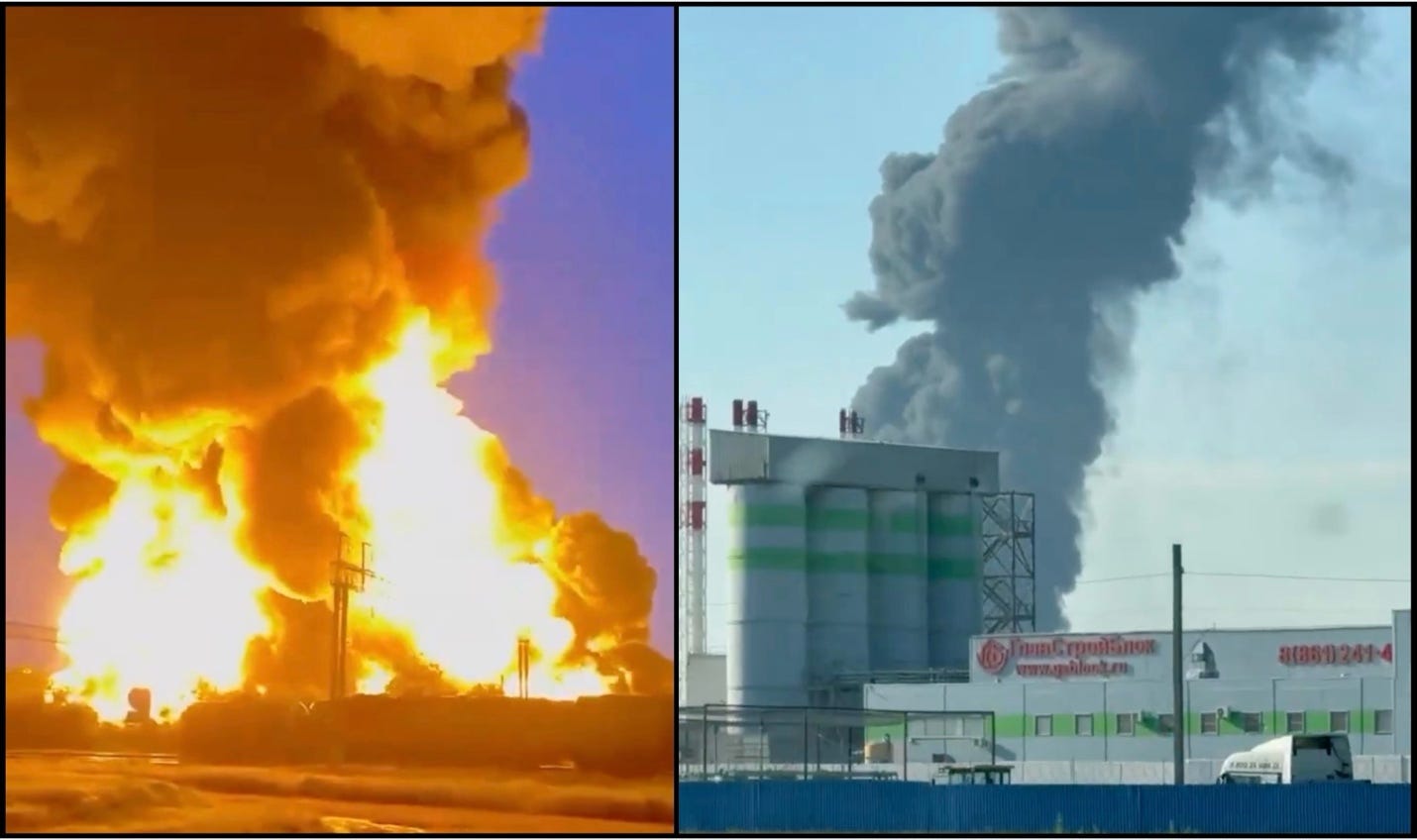
In addition to the success of its drones on the frontline, Ukraine has developed the capability to deploy drones and missiles deep inside Russian territory. In June 2025, Ukraine launched Operation Spider’s Web, targeting dozens of aircraft in Russia’s long-range bomber fleet. Ukrainian drones, smuggled into and launched inside Russia, struck more than 40 aircraft as they sat stationary at airbases as far afield as eastern Siberia and the Arctic Circle. Ukrainian companies have also designed and now deploy their own long-range missiles, including, most impressively, the Flamingo FP-5, with ranges over 1,000 kilometers. Every day now, military targets deep inside Russia are being hit. Putin was so paranoid about Ukrainian drones hitting Moscow during the May 9th celebration of the Soviet victory over Nazi Germany that he called for a temporary ceasefire. During the St. Petersburg International Economic Forum, Putin’s version of the World Economic Forum, Ukrainian armed forces struck fuel facilities in the region, creating lasting images of black smoke in the distance as delegates arrived at the event. Celebrations of Russia’s National Day on June 12th were dramatically scaled back out of fear that Ukrainian strikes might disrupt them. Over time, Ukraine’s ability to strike targets deep inside Russia will expand. Fire Point, the Ukrainian company that makes Flamingos, is expected to deploy ballistic missiles (the FP7 and FP9) with even longer ranges this fall.
A fifth indicator that Russia is losing this war is the shocking number of casualties. According to the Center for Strategic and International Studies (CSIS), an estimated 1.2 million Russian soldiers have been killed, wounded or reported missing; NATO General Secretary Mark Rutte said on 3 June that more than 30,000 Russian soldiers were dying each month in Ukraine. “This means losing more men in one month than the Soviet Union did in 10 years in the 1980s in Afghanistan,” he said. Of course, Ukrainian soldiers are dying at tragic rates, too. And obviously, Russia’s larger population gives Putin an advantage in this kind of attritional contest. At the same time, for every Ukrainian soldier lost on the battlefield, Russia is losing at least two more, according to CSIS estimates. Speaking in April, Finnish President Alexander Stubb claimed that this ratio was as much as 1:5. Putin cannot sustain that rate of death without instituting a highly unpopular draft. Regarding this aspect of the war, time is no longer on Putin’s side.
A sixth metric of Ukraine’s growing advantage in this war is how well Zelenskyy, his government, and his armed forces have managed Trump’s abandonment of their cause. When Trump was first reelected, many of my friends in Ukraine quietly cheered. They had high (and it turned out, false) hopes that the alleged master dealmaker in the White House would negotiate an end to the war. After all, as a presidential candidate, he had pledged to do so. I sensed that many Ukrainians were prepared to accept huge sacrifices, including acquiescing to Russian occupation of large swaths of Ukrainian territory, if Trump could leverage that sacrifice for peace. (I wrote about such scenarios in this Foreign Affairs article, “How Trump Can End the War in Ukraine.” But Trump did not even really try. Instead, Trump and his negotiators gave up their best cards—ending military assistance to Ukraine and publicly denying Ukrainian membership into NATO—without getting anything in return from Putin. Special envoy Steve Witkoff and businessman Jared Kushner were not neutral mediators. They seemed more focused on future economic deals for Americans in Russia than peace in Ukraine. (Witkoff has visited Moscow several times but has never once been to Kyiv. Hardly “shuttle diplomacy.”) That their efforts have withered has disappointed few in Kyiv.
Amazingly, Zelenskyy and his team have survived Trump’s initial pro-Putin pivot. When Trump refused to approve any new military and economic assistance to Ukraine beyond what Biden and the U.S. Congress had previously approved, many predicted disasters for Ukraine’s army and its economy. As journalist and historian Anne Applebaum rightly recalled: “When the Trump administration stopped sending military and financial aid to Kyiv in 2025, some in Washington expected (and maybe wanted) the end to come quickly.” That did not happen, in part because of European support, and in part because of Ukrainian military innovations. Despite the personal attacks by Trump and his vice president, J.D. Vance, during a White House meeting in February 2025, Zelenskyy has avoided a complete breakdown in ties between Kyiv and Washington, while also abandoning false hopes that Trump and his team might help Ukraine end the war on honorable terms. For maintaining this delicate balancing act, credit is due to Zelenskyy, Ukrainian government officials (the channel between Secretary of the Treasury Scott Bessent and Prime Minister Yulia Svyrydenko has been particularly important), and diplomats, including Ukraine’s talented ambassador in Washington, Olga Stefanyshyna, who have played an important role in maintaining cordial ties between the US and Ukraine under challenging circumstances.
Seventh, Ukraine has scored another win in Europe. Zelenskyy and his team have succeeded in maintaining and even expanding European support, despite Putin’s best efforts to divide Europe. Most importantly, European democracies have continued to provide military and economic assistance to Ukraine, which became especially critical after Trump wound down such aid from the United States. The change of government in Hungary was another victory for Ukraine (and a blow for Putin), unlocking 90 billion euros in aid that had been blocked by Hungarian PM Viktor Orban and boosting Ukrainian hopes of one day joining the EU. Furthermore, Ukrainian diplomacy has facilitated the maintenance and incremental expansion of European sanctions against Russia over the years, hampering Putin’s ability to fund his war against Ukraine.
Finally, albeit anecdotally, I can report a new sense of optimism among the Ukrainians with whom I interact almost daily. Last winter was very hard for my Ukrainian friends, most of whom live in Kyiv. The coming winter will be hard too; they know that. But this spring has been the most optimistic moment for my Ukrainian colleagues since the fall of 2022. They sense that momentum is on their side. They see no prospects at all that Putin’s invading army can move forward. Many praise their new Minister of Defense, Mikhailo Fedorov, as the perfect person for this job at this crucial moment in Ukraine: young, tech-savvy, close to Zelenskyy, and focused on metrics and data. This sense of optimism among Ukrainians contrasts starkly with the opposite in Russia, about which I wrote previously here.
Is the End Game Near?
Unless something dramatic changes the dynamics of this conflict, the Ukrainian people, its warriors, and its leaders will continue to deny Putin his core war objectives. Putin will not subjugate Ukraine to Russia; he will not impose regime change, and he will not demilitarize a country that is today a pioneer of modern warfare. Ukraine will survive this war as a pro-European independent democracy, with most of its territory governed from Kyiv rather than Moscow. That will be a giant victory.
Sadly, however, the final contours of the end of this barbaric, tragic war are still not yet defined. On the battlefield, Ukraine’s advantage remains only slight. Ukraine today does not have the capacity to liberate its occupied territories. It may never develop that capacity. The shortages of Ukrainian soldiers on the frontline and interceptors for Patriot missile defense systems (PAC3s) to defend Ukrainian cities are real. (The latter deficit, however, might soon be diminished by the production of new Ukrainian interceptors.) And Ukrainian sacrifices in thwarting Putin’s invasion have been substantial and cannot continue forever.
At the same time, momentum on the battlefield has swung clearly to Ukrainian warriors and against Russian soldiers this spring. When victory is clearly not attainable—when the reason for fighting becomes increasingly ill-defined—unexpected things happen on the battlefield. Putin should be studying dynamics on the eastern front in World War I in 1917. To avoid a similar disaster for his regime, he should negotiate a ceasefire and declare victory now, before it’s too late. Time is no longer on his side.
NATO would be idiots to not give Ukraine membership. After all,they have done something none of them have done- Stand up to Russia!!
VICTORY FOR UKRAINE 🇺🇦