


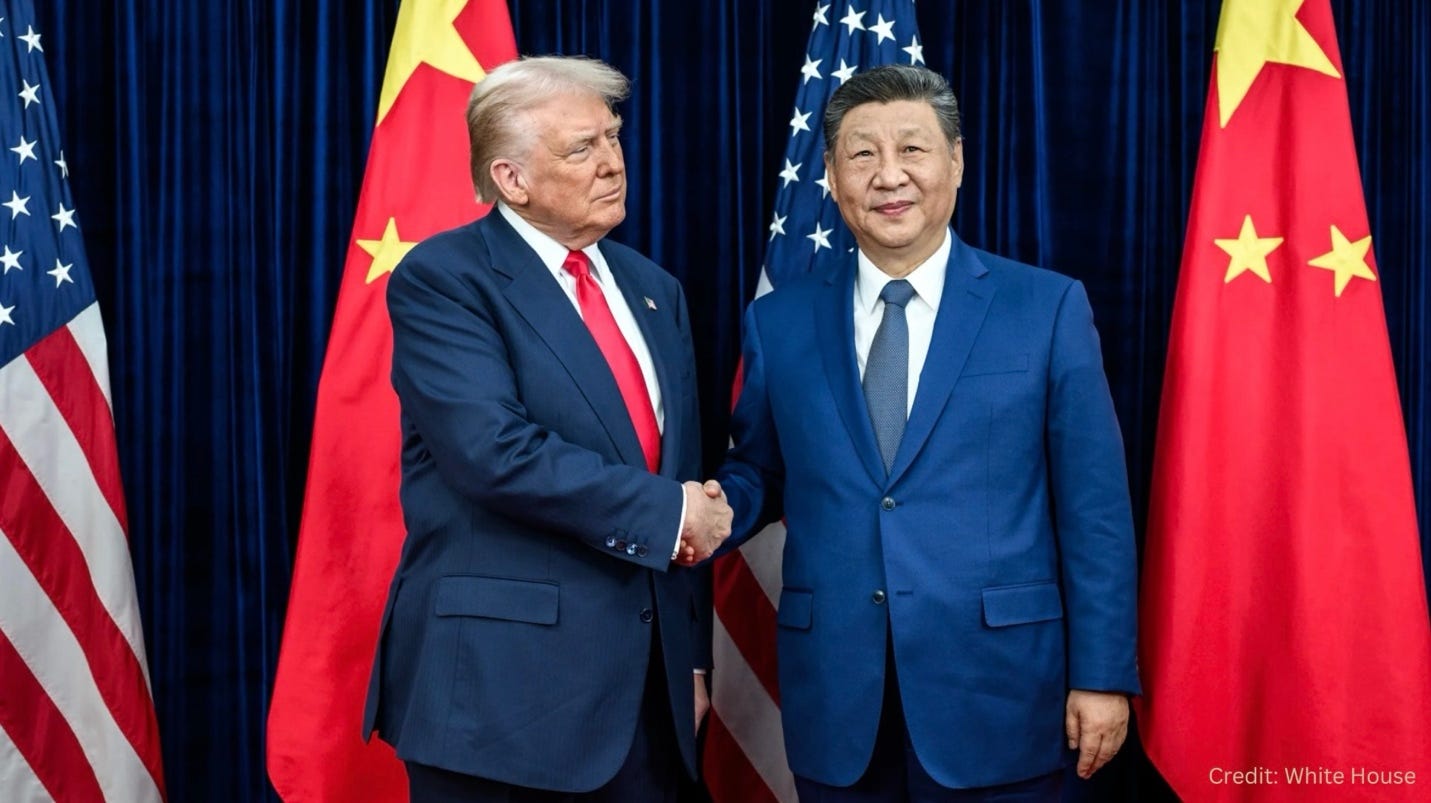
When Chinese Communist Party Chairman Xi Jinping meets with President Donald Trump this week, he should thank him. (We know from President Zelenskyy’s first Oval Office visit with Trump’s team how much they like it when you say thank you!) In the first two years of his second term, Trump has taken a series of foreign policy decisions that have weakened America’s global position and strengthened China’s. In turn, Trump’s foreign policy has significantly damaged America’s reputation in the world, while China’s standing has risen—so much so that China is now viewed more favorably than the United States in many countries that are traditional U.S. allies. Xi has much to be thankful for.
Trump’s biggest gift to the People’s Republic of China was his decision to go to war with Iran. In the early days of that war, it looked like the Chinese economy might suffer from the same inflationary effects of rising oil and gas prices as most of the rest of the world has. After all, China is major importer of Iranian oil. The Chinese economy, however, has weathered this global economic shock better than most—in part because China’s leaders stockpiled fossil fuels, in part because China has transitioned to wind and solar much faster than other countries, and in part because China’s slower-growing economy needs less energy. When announcing a campaign of sanctions to break the Iranian economy back in August, Trump and his team had threatened secondary sanctions on those who continued to trade with Tehran. So far, however, Trump’s bark has been louder than his bite; the U.S. has not imposed these new sanctions on China. Given the expected red-carpet treatment that Trump has planned for Xi this week, expect no new U.S. sanctions on Chinese companies doing business with Iran anytime soon.
In addition to avoiding bad economic outcomes from the U.S.-Iran war, Xi and the Chinese Communist Party have directly benefited from the conflict. The Iran war has strained relations between the United States and its allies and partners, especially in Europe, but also in South Korea and in the Middle East. That’s good for Beijing. By attacking Iran without first seeking UN Security Council approval, Trump has made the United States look like a rogue actor in the international system, similar to Russian leader Vladimir Putin when he invaded Ukraine. I don’t think that comparison is accurate, as I have written about previously. But my summer travels in Europe and Asia since the start of the Iran war have made me realize that many others in the world do see the parallels. Unlike Russia and the United States, China has not invaded any country for several decades. That enhances China’s image in the world as a supporter of a rules-based international system.
In addition, Trump’s inability to achieve his stated objectives through the use of military force—ending Iran’s nuclear weapons program, stopping aid to terrorist groups, democratic regime change—makes the United States look weak. So too does our inability to reopen the Strait of Hormuz, tragically affirming Xi’s argument that the United States is a declining power. Trump has also depleted American supplies of rockets and missile defense interceptors, radically diminishing our ability to deter a Chinese invasion of Taiwan right now. More generally, the U.S. “pivot” to Asia, first championed by President Obama and embraced by the first Trump administration and then President Biden, is over for now. American military resources are flowing back to the Middle East and out of Asia. What could be better for Xi?
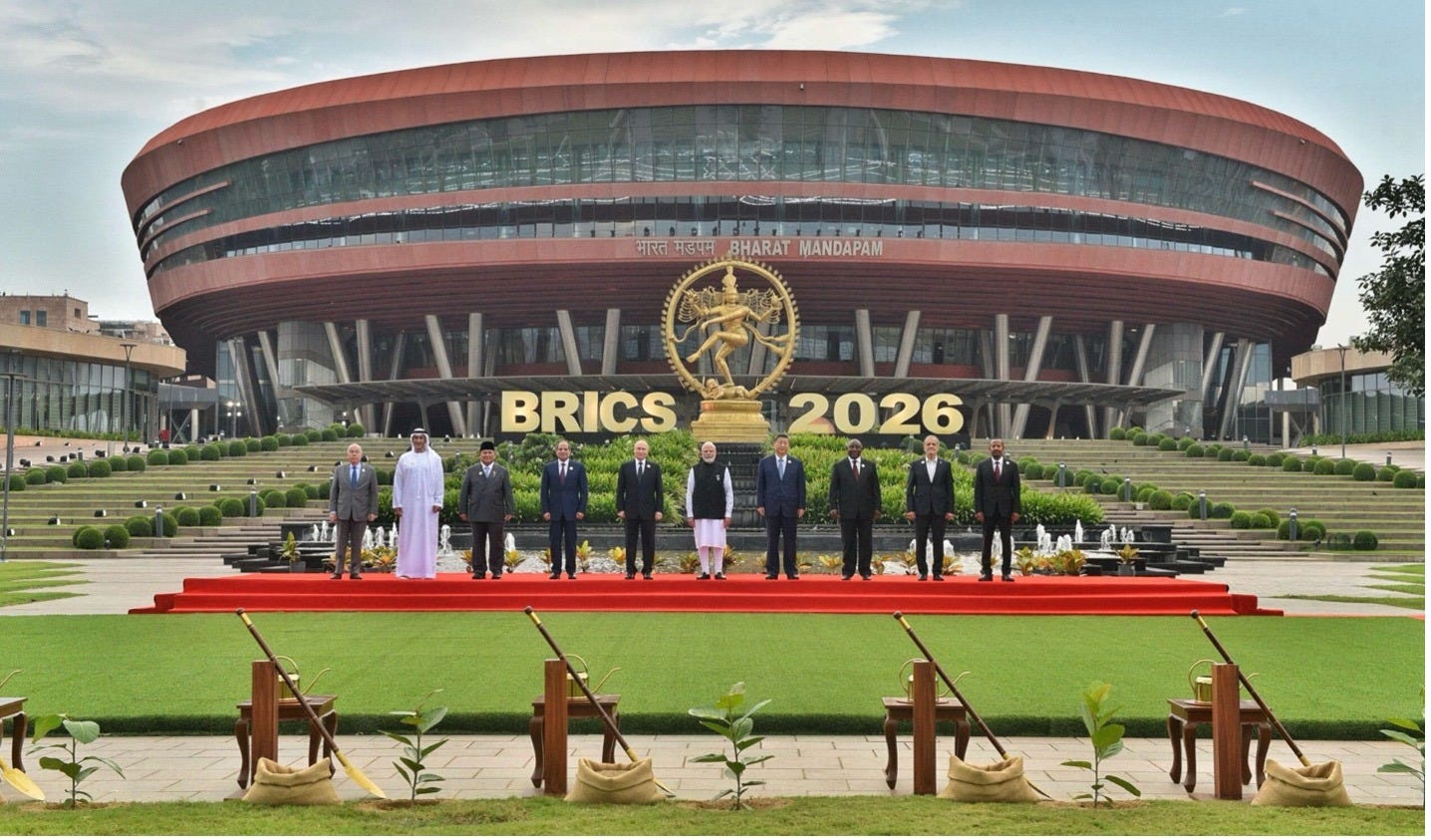
Trump’s war in Iran is a huge gift to Xi, but it is not the only one. In addition, Trump has picked a fight with Canada, threatened to invade Greenland—a semi-autonomous territory of our democratic ally, Denmark (although this crisis finally seems to be over with the signing of a new agreement with Denmark, which bears striking resemblance to the 1951 agreement)—scaled back joint military exercises with South Korea, and exacerbated tensions with several other allies with his irrational tariff policies. In competing with China in the 21st century, our allies should constitute a major advantage for the United States. Trump is destroying this advantage. Meanwhile, as Trump undermines relations with our democratic allies, Xi is working to strengthen ties among autocrats through groupings such as BRICS and the Shanghai Cooperation Organization (SCO), as shown by their recent summits this fall.
Trump has also helped China’s most important ally, Russia. The Trump administration has continued to provide intelligence to Ukraine and allowed American weapons to be purchased for Ukraine. At the same time, Trump has cut all direct US economic and military assistance to Ukraine to nearly zero. Trump also made clear his opposition to Ukraine joining NATO. He hosted Putin in an elaborate summit in Alaska last summer and has only very modestly expanded sanctions on Russian firms. Whether Trump will use the new authorities granted to him in the recently passed sanctions law is unclear. (Count me as part of the skeptical crowd, but I’m trying to keep an open mind.) He has done nothing to disrupt Chinese imports of Russian fossil fuels or Chinese exports of components used by Russian companies to build weapons. Helping Xi’s strategic ally is indirectly helping the People’s Republic of China.
Another Trump gift to Xi is the president’s complete abandonment of supporting democracy and human rights abroad. Trump has never devoted any effort to supporting human rights activists or democratic advocates in autocratic countries, including China. Trump admires autocrats. Even in Venezuela, where Trump ordered the extraction of autocratic leader Nicolas Maduro in a military operation, he has continued to work closely with Maduro’s former vice president, Delcy Rodriguez. Chinese public statements and leaked documents show that Xi fears American democracy-promotion efforts. Chinese leaders understand that the advance of democratic ideas, leaders, and movements undercuts their rationales for autocratic rule. (For more on this topic, see Autocrats versus Democrats: China, Russia, America, and the Global Disorder.) But Trump has radically diminished this fear for Xi and his Communist Party, while disappointing small-d democrats around the world who are struggling to consolidate new democracies, or fight against dictatorships. Who benefits most from this pivot? Xi.
Relatedly, Trump has weakened America’s ability to compete with China around the world by destroying valuable instruments of American influence, such as the United States Agency for International Development (USAID) and government-funded broadcast organizations like Voice of America, Radio Free Asia, and Radio Free Europe. Some of the organizations are partnering with allies in Congress to fight back, but the damage is already deep. At the same time, Xi is not cutting back on China’s instruments of influence, be that economic initiatives like the Belt and Road Initiative (BRI), institutions like the Asian Infrastructure Investment Bank (AIIB), or media outlets like the state-run international broadcaster CGTN. Trump has also weakened the State Department by firing scores of diplomats. China, meanwhile, maintains an extensive diplomatic presence around the world. Its Foreign Ministry lists 298 overseas posts as of July 2026, compared with 279 U.S. posts in the State Department’s latest comparable count. Trump is also cutting funding for international student exchanges; Xi is expanding these programs in China.
Measuring precisely the cause and effect between these U.S. policy changes and declines in America’s reputation worldwide is difficult. The correlation, however, is robust. A 2026 Pew Research Center survey found that China is now viewed more favorably than the United States in 27 of 36 countries polled—a reversal from 2025, when most still viewed the U.S. more positively than China. Pew said in a separate report that favorable views of the United States had “declined significantly” in 15 of 24 countries with comparable data over the last year. The erosion of trust among some of America’s closest allies has been especially dramatic, with positive ratings of the U.S. “at or near the lowest they’ve been” in Australia, Canada, France, Germany, South Korea, Italy and the UK. In Canada, for instance, the percentage of respondents who said they regard the United States as a reliable partner has fallen from 83% in 2022 to just 35% today, Pew noted.
In the long run, Xi Jinping faces major obstacles to competing effectively with the United States and the free world. The Chinese economy is sagging, with increasing state intervention contributing to weaker productivity growth and inefficient resource allocation. Demographic challenges—getting old before getting rich—will only worsen China’s economic woes in the coming decades. If the free world can remain united, it has more combined military and economic power than China and its autocratic allies do. Despite Trump’s assaults on democratic institutions and norms at home, and indifference to democracy’s fate abroad, global public opinion polls show that democracy remains a more popular form of government around the world than dictatorship. The international popularity of democracy remains an important long-term advantage for the U.S. and its allies. But we have to get to the long term. In the short-term, Trump has strengthened the global position of autocratic China. The sooner these policies are reversed, either by Trump or a future U.S. president, the better.
Excellent point on Iran. Months ago I said this would never end. Iran already won.
Now watch the President of the United States walk into the United Nations, gold seal glowing behind him like a Motel 6 halo, and announce his big decision. Make a deal, or "annihilate" the nation. That is the entire menu. Those are the options a winner brings to the table.
Sit with what that sentence confesses. You do not stand at a podium threatening to annihilate a country you have already beaten. You threaten annihilation when their drones cost twenty thousand dollars and your interceptors cost three million. You threaten it when the Strait already did the wet work on your own economy and you have nothing left to squeeze. Annihilation is not a plan…it’s noise from a drunk fool.
He is not deciding. He is auditioning. "Deal or annihilate" is not a choice. It is a tantrum with two settings, and Iran gets to choose which one humiliates him more slowly.
A farce. A fart with a flag pin. Same thing I said in spring, same thing I will say in winter. The war does not end because ending it is the one outcome that helps nobody holding a microphone.
Iran won. Trump is still arguing with himself about how much more he can destroy America’s standing in the world. As USA digs coal and imprisons children, moms, and youth,
China’s EVs are taking over the world, and they are super impressive! China won.
🐌
This excellent post by @Michael McFaul offers a cool and dispassionate assessment of the countless foreign policy advantages China has derived from the decisions and actions of the current US administration. If one had designed and implemented an approach to international relations intended systematically to undermine US interests and standing while reinforcing the interests of US rivals and competitors, one could not have done the job any better than Mr. Trump has done. This begs the unasked taboo question: Was it? (My guess is that Xi can't believe his luck.)
I'm not sure this unparalleled historical accomplishment deserves our congratulations, but I am convinced by the exhaustive trail of evidence that President Trump has no intention of reversing course or seeking to limit the damage. Au contraire, I think we can expect him to continue digging the United States deeper and deeper in the same incoherent, if not perverse direction. Any reversal of course and resumption of sanity will require the election of a sane, capable, democratically-minded successor who is fully aware of the situation, including internationally. Should the United States be so lucky, that person and their team will have their work cut out for them.
Fittingly in this connection, at the UNGA this morning, the American president reportedly repeated his refrain, to the continued bewilderment of the international audience, that the United States is now "hotter" than ever before. I wonder why that weird word in this context sounds less good than it should?